May 14, 2026 · 10 min read
Types of Wood for Making Great Wooden Toys
An educational guide to the hardwoods and softwoods used in quality wooden toys — how each wood looks, what it costs, how it is worked, and why toymakers choose it.
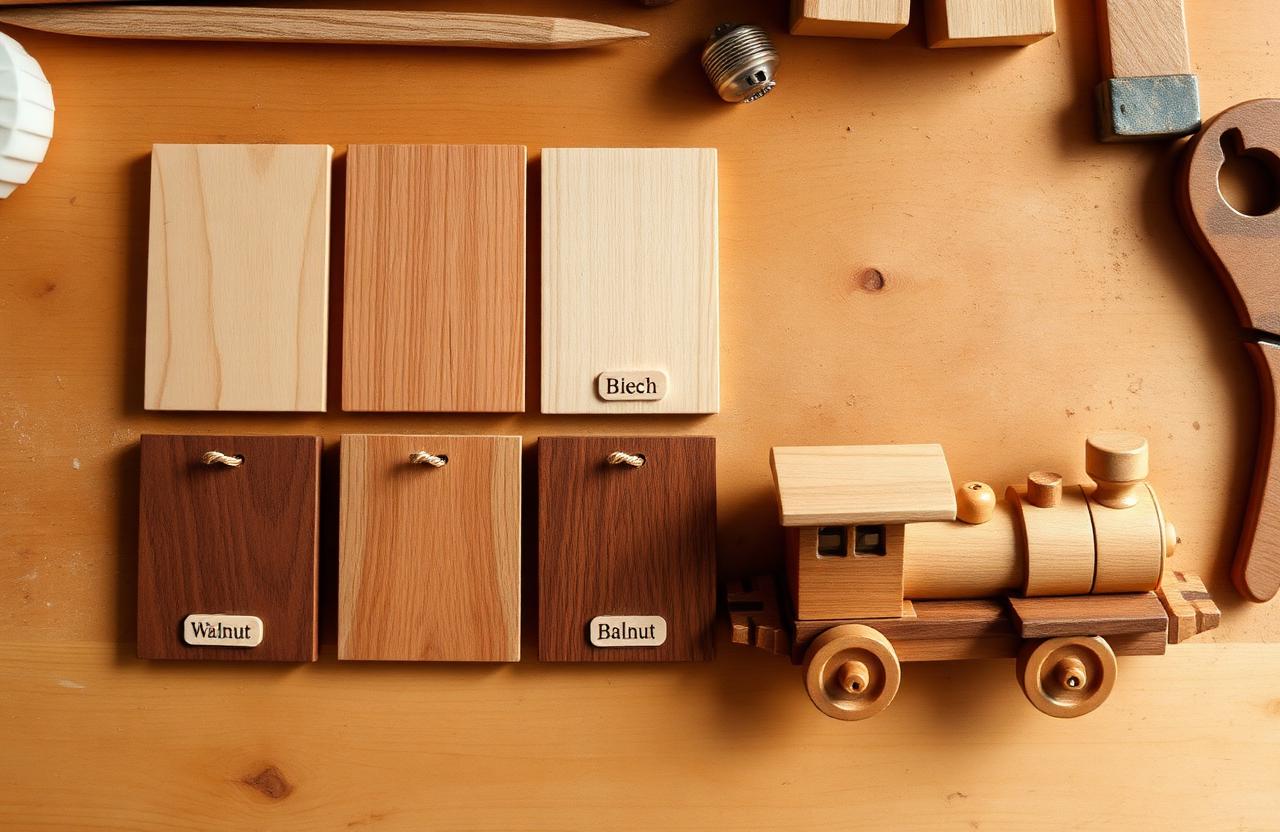
When parents pick up a wooden toy, most of them experience it as one undifferentiated thing — 'wood.' Inside the workshop, that word covers a small library of very different materials, each with its own personality, price, and best use. A stacking ring carved from hard maple behaves nothing like a hand-painted figurine cut from basswood, and a heirloom rocking horse in cherry is a completely different object from a Baltic birch jigsaw puzzle. Understanding the handful of woods that dominate fine toymaking is the fastest way to understand why quality wooden toys feel the way they do, why they cost what they cost, and why a good maker reaches for one species rather than another.
Before we get to specific species, it helps to know the two big categories every toymaker thinks in: hardwoods and softwoods. The terms have nothing to do with how hard the wood actually feels — balsa is technically a hardwood and is famously soft. They refer to the type of tree the wood comes from. Hardwoods come from broad-leaved, slower-growing trees (maple, oak, cherry, walnut, beech, birch) and tend to be denser, finer-grained, and more durable. Softwoods come from coniferous, faster-growing trees (pine, spruce, fir) and tend to be lighter, easier to work, and less expensive. For toys that will be dropped, chewed, stacked, and handed down, hardwoods do most of the heavy lifting — but a few softwoods earn a place too.
The other framework worth knowing is the difference between solid wood and engineered wood. A solid wood toy is cut directly from a single piece of lumber; an engineered toy uses something like plywood, where thin layers of wood are glued together with their grains running in alternating directions. Plywood is enormously strong for its weight and resists warping, which makes it ideal for thin parts like puzzle bases and laser-cut shapes. The crucial caveat: only specific food-safe, low-formaldehyde plywoods (most famously Baltic birch ply) belong anywhere near a child. The cheap construction plywoods from a hardware store are not toy materials.
Hard maple is, without much exaggeration, the gold standard of North American toymaking. It is creamy white when freshly milled and warms to a soft honey colour over the years. Its grain is famously tight and even, so it sands to a glassy smoothness and never splinters when chewed. It is extremely dense — at about 705 kg/m³ — which means a maple block has a satisfying heft and survives being dropped from a high chair indefinitely. Cost is moderate to high; in 2026 prices, kiln-dried hard maple typically runs CAD $9–14 per board foot wholesale, more than birch but less than walnut. Because it shows so little colour variation, makers love it for paint-grade work and for any toy whose shape, not its grain, is the point — stacking rings, shape sorters, geometric block sets, threading beads, and most Montessori sensorial materials. It machines beautifully on the lathe (it is hard enough to take crisp detail) and it turns wheels and dowels that stay round for decades.
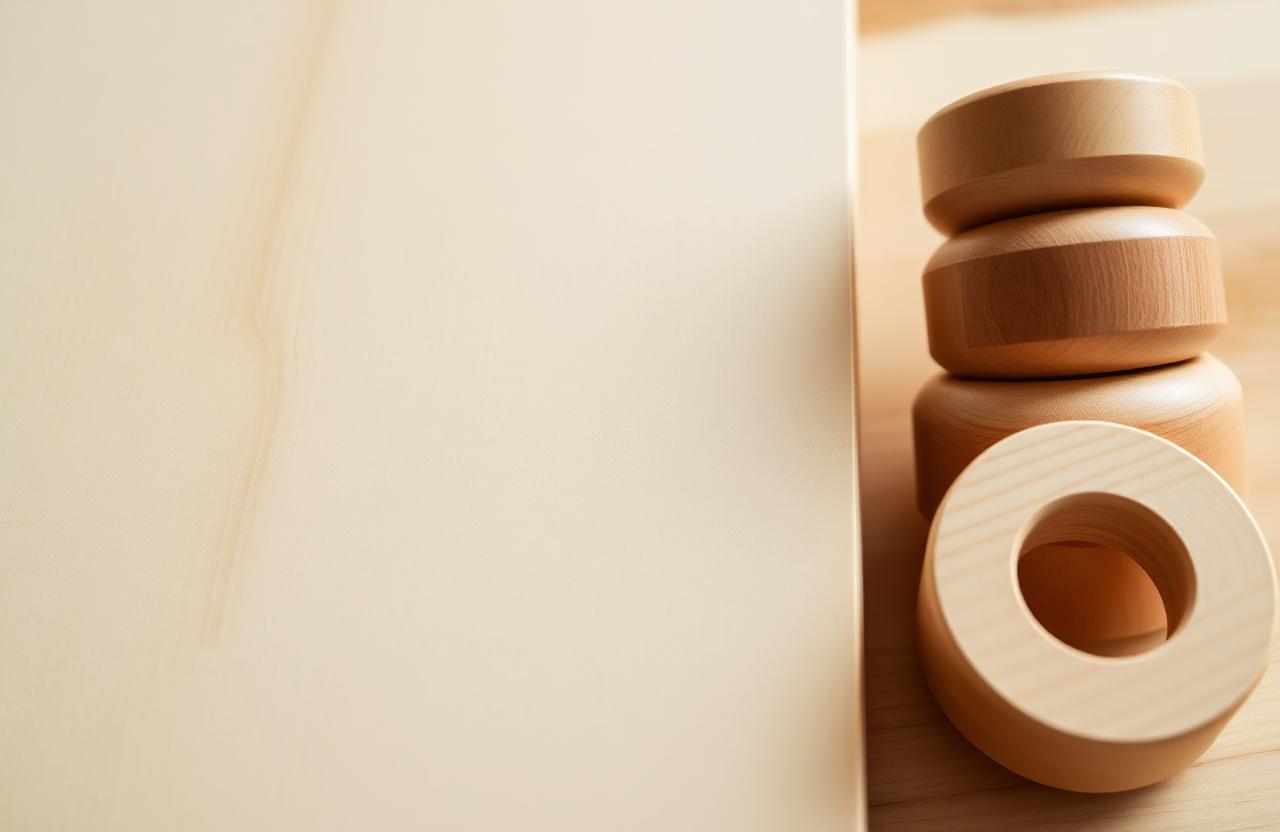
European beech is the quiet hero of the global wooden toy industry. Walk through a German, French, or Polish toy factory and beech will be everywhere. It has a pale pinkish-tan colour, a very straight tight grain, and a hardness almost identical to hard maple. What makes beech special is its consistency and its price: well-managed European beech forests produce huge volumes of clear, knot-free, dimensionally stable lumber, which keeps the cost around CAD $7–10 per board foot — noticeably cheaper than maple or cherry. Beech also steam-bends well, which is why classic bent-wood pull toys, hoops, and curved rockers are so often beech. The downsides are minor: it can move a little with humidity changes and it is less rot-resistant if a toy ever lives outdoors. For shape sorters, simple vehicles, building sets, kitchen play pieces, and the vast catalogue of mid-priced European wooden toys, beech is almost always the answer.
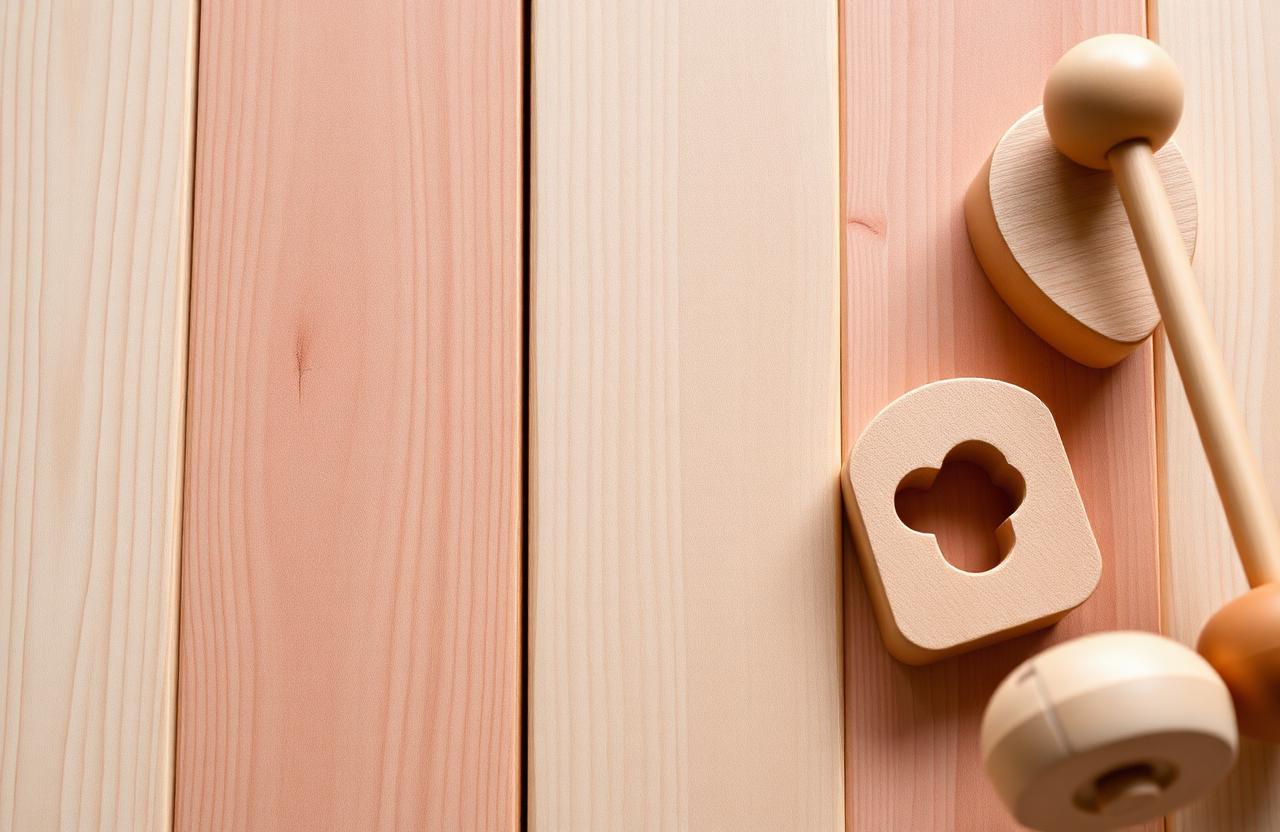
Birch — and specifically Baltic birch plywood — is the engineering wood of the toy world. Solid birch is a pale, slightly yellow hardwood that is roughly two-thirds the density of maple, easy to machine, and pleasant to sand. But birch's real fame comes from the plywood made from it: thin birch veneers laminated with alternating grain directions and a low-emission glue, producing sheets that are extraordinarily strong, perfectly flat, and stable across humidity changes. Baltic birch ply costs around CAD $80–140 per 1.5m × 1.5m sheet depending on thickness and grade, and it is the material of choice for puzzle bases, laser-cut animals, lacing boards, peg boards, dollhouse walls, and any toy where you need thin, strong, dimensionally precise parts. Solid birch is also a common choice for budget-friendly solid toys where the maker wants hardwood durability without the higher cost of maple. Quality matters here: insist on B/BB grade or better Baltic birch certified to CARB Phase 2 or E1 formaldehyde standards, because that is what makes it safe for chewing children.
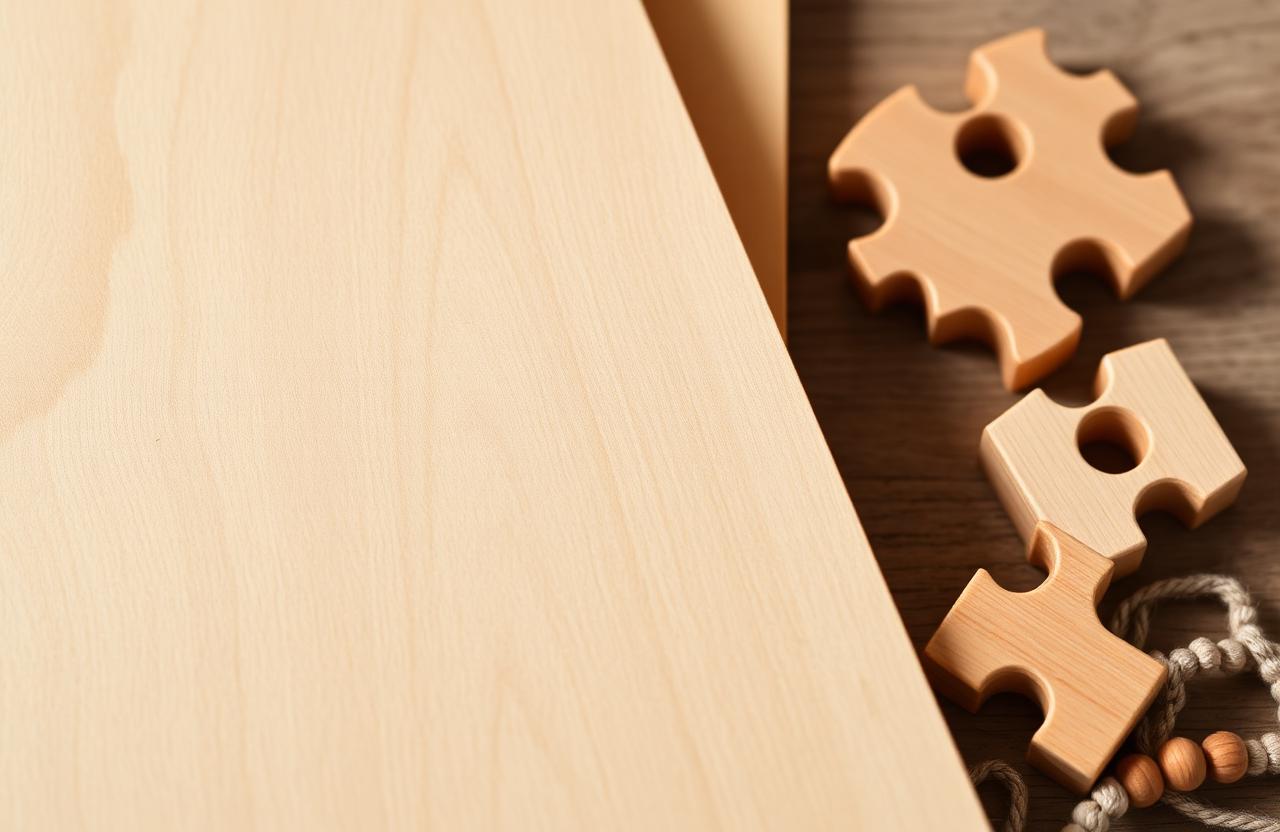
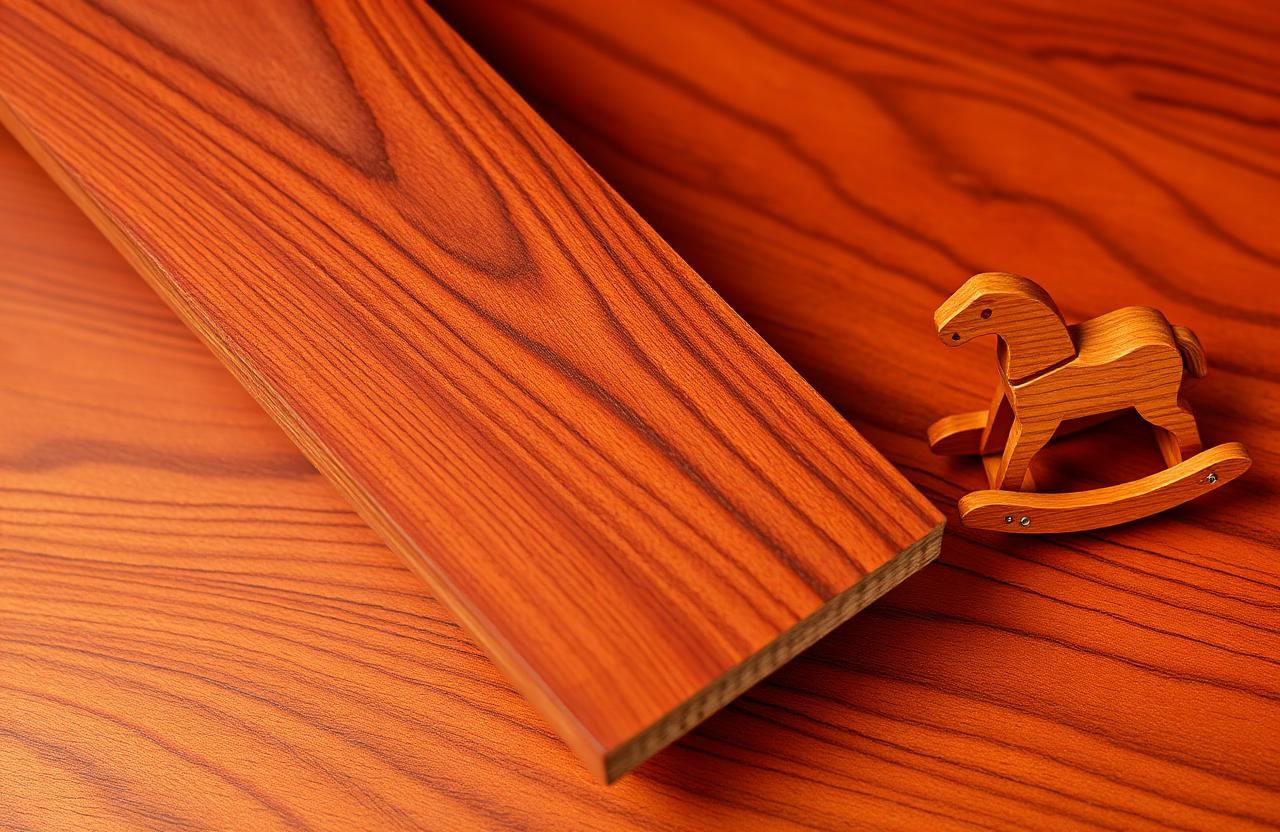
Cherry sits firmly in the heirloom tier. Freshly milled, it is a pale pinkish-brown; within a year of normal light exposure it deepens into the rich reddish-mahogany colour everyone associates with fine furniture. The grain is fine and elegantly figured, the wood is moderately dense (around 580 kg/m³), and it sands to a satin sheen that almost glows under finish. Cherry costs more than maple — typically CAD $12–18 per board foot — because the trees grow slowly and clear cherry stock is increasingly hard to source. Toymakers tend to reserve it for gift-quality pieces: heirloom rocking horses, beautifully turned spinning tops, premium chess and checkers sets, baby teethers and rattles where the natural colour is the entire aesthetic, and limited-edition trains and vehicles. Cherry is slightly softer than maple, so it dents a little more easily, but every dent becomes part of the toy's story. It also takes engraving and pyrography exceptionally well, which makes it the natural choice for personalised gifts.
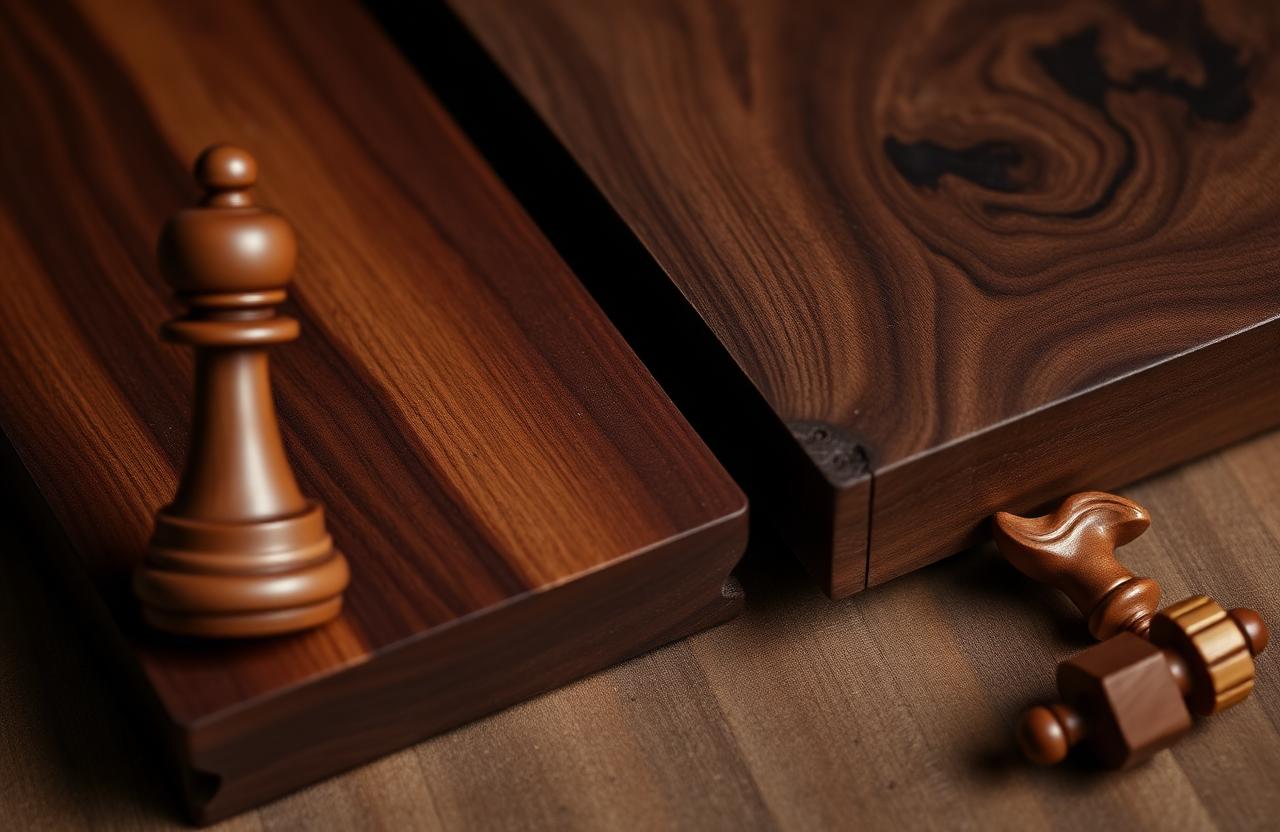
Black walnut is cherry's even more dramatic cousin. It is one of the only North American hardwoods that is naturally dark — a deep chocolate brown, sometimes almost purplish, with bold flowing grain and occasional sapwood streaks. Density is moderate (around 610 kg/m³) and it works beautifully under hand tools, taking very crisp detail on the lathe and under a chisel. Walnut is the most expensive of the common toy hardwoods, often CAD $15–22 per board foot, and well-figured pieces command much more. For that reason, you rarely see entire toys made of walnut; instead, makers use it as an accent — dark wheels on a maple train, walnut roofs on a cherry dollhouse, walnut chess pieces against a maple board, dark walnut animals against pale basswood scenery. Where walnut is used solid, it almost always signals a true heirloom piece: an engraved baby rattle, a premium music box, a wedding-gift wooden puzzle.
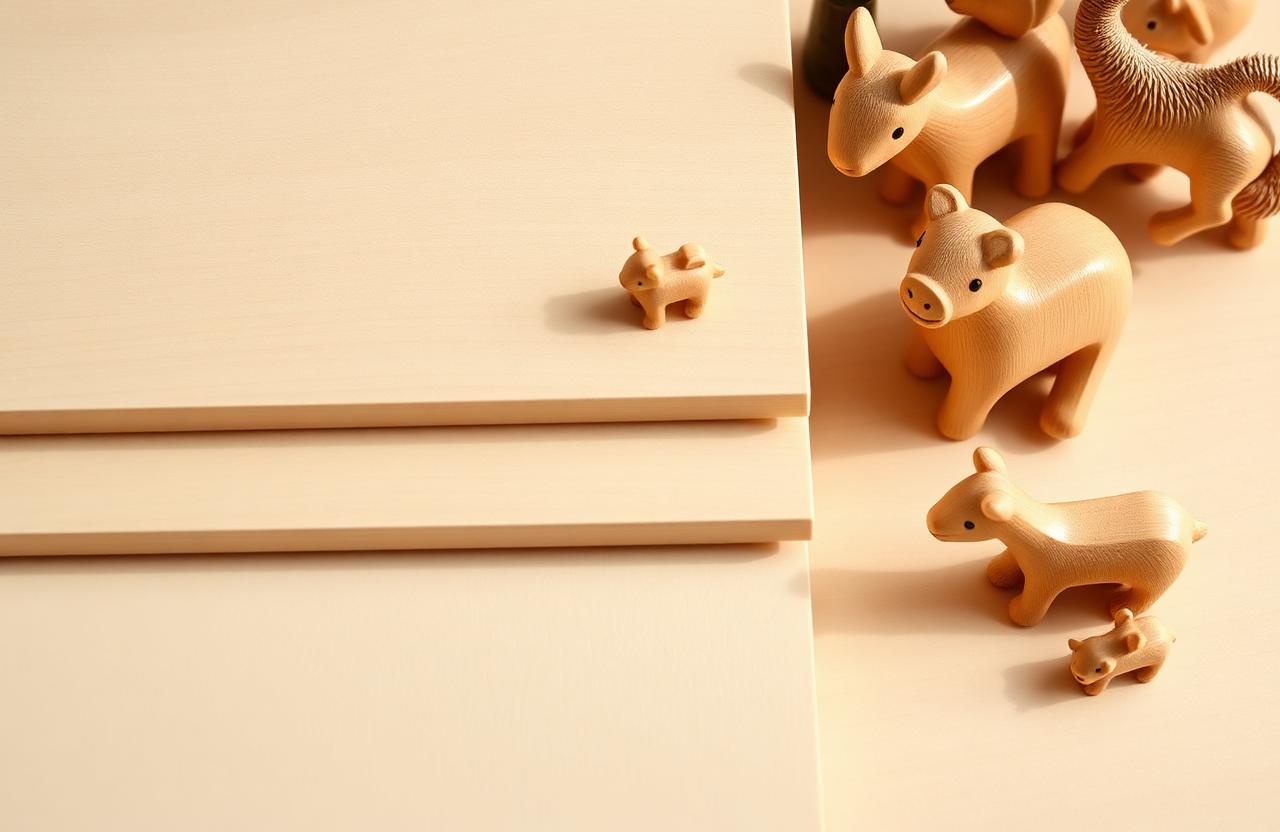
Basswood (called lime or linden in Europe) is the carver's secret. It is a hardwood by botanical classification but feels almost as soft as pine, with a creamy, almost white colour and an exceptionally fine, even grain. It is the easiest of all toy woods to carve with a knife and it holds remarkably crisp detail for such a soft wood. Density is low — around 415 kg/m³ — so basswood toys feel pleasantly light. Cost is moderate, around CAD $6–9 per board foot, and clear basswood is widely available. Toymakers use basswood for hand-carved animals and figurines, simple block sets aimed at younger children who would find heavier hardwoods tiring, painted toys (basswood is the best paint-grade wood there is, because its smooth even surface takes pigment uniformly), and anything carved by hand on a small scale. The trade-off is durability: basswood dents and dings more easily than maple or beech, so it is not the wood for a marble run or a toddler hammer toy. For pretend-play animals, nativity scenes, and decorative pieces, however, nothing else comes close.
Two more woods deserve honest mention. Rubberwood (from the plantation rubber tree, once it stops producing latex) is a pale, medium-density hardwood that has become the dominant material in mass-market wooden toys from South-east Asia. It is genuinely sustainable — the trees are felled at end-of-life from existing rubber plantations — and it is cheap, often CAD $3–6 per board foot equivalent. The catch is that rubberwood almost always arrives finger-jointed (small pieces glued together) and chemically treated against fungus and insects, so the safety of any specific rubberwood toy depends entirely on the quality of those glues and treatments. Reputable makers using EN 71-3 or ASTM F963-tested finishes make perfectly safe rubberwood toys; the cheapest market stalls do not. Pine and spruce, the most common softwoods, are occasionally used for very large lightweight toys (toy chests, big building planks, train tables) where weight matters more than dent resistance, but they splinter too easily for small toys and almost never appear in pieces that go in the mouth.
How the wood is chosen shapes how the toy is made. Hard maple and beech go to the table saw, the band saw, and especially the lathe, because they are dense enough to take fast machining without tearing out. Cherry and walnut are often hand-finished with cabinet scrapers and hand-sanded through finer grits because their figured grain rewards careful, slow work. Baltic birch ply goes to the CNC router or laser cutter, where its perfectly flat sheets allow batch-produced parts with sub-millimetre precision. Basswood is the one wood routinely shaped with hand carving knives and gouges, often by a single craftsperson from rough blank to finished animal. Every species has its own dust personality too — beech dust is fine and irritating, walnut dust can sensitise some makers, basswood dust is among the most pleasant — and good workshops match dust extraction and ventilation to the wood being run that day.
Finishing choices follow the same logic. Pale woods like maple, beech, birch, and basswood take natural oil-and-wax finishes that show off their honest light colour without yellowing them too much. Cherry and walnut are usually finished with the lightest possible coat — often just a single application of pure linseed or tung oil — because anything heavier muddies their figure. Any wood meant for an under-three child must finish food-safe, which in practice means linseed oil, tung oil, beeswax, carnauba wax, or certified toy-safe water-based stains and lacquers tested to EN 71-3 or ASTM F963. The wood and the finish are chosen together, not in sequence: a maker who knows the piece will be finished in clear beeswax will pick the wood that looks best under exactly that finish.
Cost, in the end, is the honest reason makers choose one wood over another as much as aesthetics or performance. A simple set of natural stacking rings made in beech might land at a retail price of CAD $35; the same set in cherry can easily reach $75, and in figured walnut, well over $120 — and every dollar of that difference is, in part, the raw lumber cost flowing through. None of these woods is 'better' in the abstract. Beech is better for a robust, affordable shape sorter; cherry is better for a christening-gift baby rattle; Baltic birch is better for a 24-piece puzzle; walnut is better for a chess set built to be played with for fifty years; basswood is better for a hand-carved animal that will live on a child's bookshelf. A good maker chooses the wood to match what the toy is supposed to do, and that match is most of the reason a great wooden toy feels great in the hand.
When you next pick up a wooden toy, look at it for a second longer than usual. Notice the colour and the grain. Press a fingernail gently into a corner — does it dent easily, or does the wood resist? Roll it in your palm to feel the weight. Most of the time you can guess the species, and once you can, you can read the maker's whole set of decisions: what they wanted the toy to do, who they made it for, how long they expected it to last, and how much they were willing to spend on the wood that would carry all of that into the playroom. That is the real education in wooden toys. It begins, as it always has, with the wood.
Keep reading
More from the journal
How Montessori Toys Stimulate Young Children
Why simple, purposeful toys built on Montessori principles spark deeper concentration, creativity, and confidence in early childhood.
Why Wooden Toys Are Better Than Plastic Toys
From safety and sensory richness to lifespan and environmental impact, here is the honest case for choosing wood over plastic in the toy box.
The Science Behind Montessori Toys
Montessori materials are not a trend — they are the result of more than a century of careful observation and converging modern neuroscience.