April 9, 2026 · 6 min read
Why Wooden Toys Are Better Than Plastic Toys
From safety and sensory richness to lifespan and environmental impact, here is the honest case for choosing wood over plastic in the toy box.
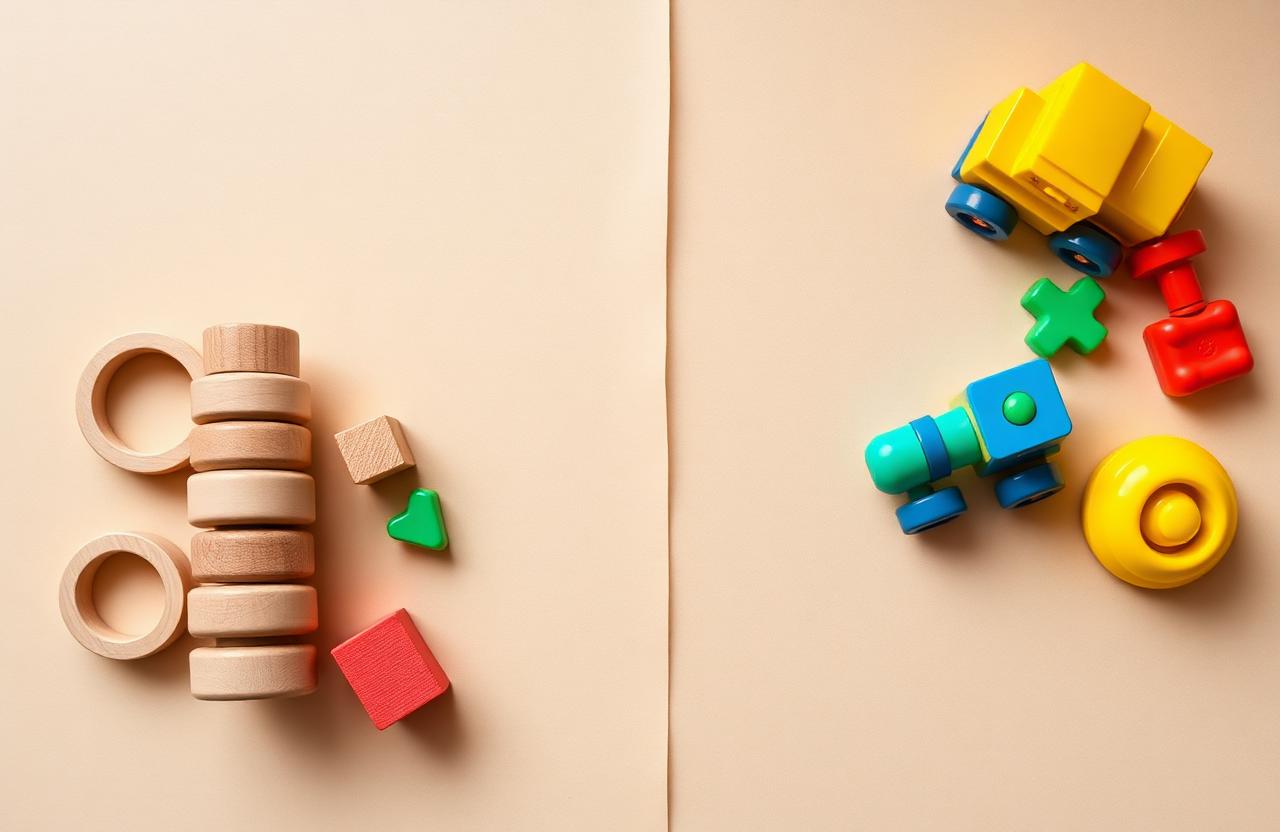
Walk through the toy aisle of any big-box store and the message is clear: plastic has won. Bright primary colours, glossy surfaces, packaging designed to shout from the shelf. It is cheap, it is loud, and it is everywhere. And yet, quietly, more and more parents are walking past those aisles and reaching instead for something heavier, simpler, and warmer in the hand — a wooden toy. The shift is not nostalgia. It is a calm, well-reasoned response to what we now know about child development, safety, materials, and the planet our children will inherit.
Start with safety, because for any parent of an infant it is the only place to start. A well-made wooden toy is a single solid piece of a known natural material, finished with food-grade beeswax or linseed oil. There is nothing to leach. By contrast, plastic toys are a chemistry experiment in your child's mouth. Even reputable plastic toys can contain phthalates, BPA, BPS, PVC stabilisers, and flame retardants that have been linked, in study after study, to endocrine disruption and developmental concerns. Recalls of contaminated plastic toys are a recurring news story. A wooden block does not get recalled for chemical contamination, because there is no chemistry to fail.
Then there is the sensory experience, which matters more than most adults realise. Young children learn through their hands and mouths. They are gathering data — weight, temperature, texture, grain, smell — and building a model of how the physical world behaves. Wood has all of these qualities in abundance. It is cool to the touch when you pick it up, then slowly warms to your hand. It has a faint, honest smell. The grain catches the light differently from every angle. Plastic, in comparison, is sensory monotone: same weight, same temperature, same feel across the entire object. Children handle a wooden toy differently because there is more to notice, and noticing is the foundation of learning.
Wooden toys also tend to be simpler, and simpler toys do more developmental work. A plastic toy with a button that triggers a song does the playing for the child. A wooden train, a set of blocks, a shape sorter — these demand that the child supply the imagination, the narrative, the engineering. The child becomes the active agent and the toy becomes the supporting cast. Decades of child-development research have converged on the same conclusion: open-ended, low-stimulation toys produce longer attention spans, richer pretend play, and stronger problem-solving than electronic toys, full stop. Wood, by its nature, lends itself to that kind of simplicity.
Longevity is the next big advantage, and it has both emotional and environmental dimensions. A decent wooden toy, cared for casually, will outlast its first owner. The same nesting cups that the eldest used at twelve months can come down from the shelf for the youngest. Many of our customers report that the toys they bought five or ten years ago are still in active rotation. Plastic toys, by contrast, are notorious for short lifespans — they crack, the batteries die, the electronics fail, the colours fade — and they tend to end up in landfill in a few months. The cost-per-year of a $40 wooden toy that lasts a decade is dramatically lower than the cost-per-year of half a dozen $15 plastic toys that don't.
And once the wooden toy's life with one family is over, it has options. It can be passed to a cousin, sold second-hand, donated, or — at the very end of its long life — composted or burned cleanly. A plastic toy has essentially one destiny: a landfill or, at best, a recycling bin where, realistically, most toy plastics are not actually recycled. Globally, the toy industry is one of the most plastic-intensive consumer sectors, and the toys we throw away today will outlast our grandchildren. Choosing wood is, in a very direct way, choosing to leave less behind.
There is one more, harder-to-quantify reason: aesthetics and the home environment. A well-designed wooden toy looks like an object, not a billboard. It blends into a living room. It can sit out on a shelf without screaming for attention. That matters because the toy stays accessible to the child, instead of being hidden away because it is visually overwhelming, and because it teaches the child, subtly, that beautiful and useful are not opposites. None of this means every plastic toy is bad or every wooden toy is perfect. But across safety, sensory richness, developmental value, lifespan, and environmental impact, the case for wood is honest and consistent. When in doubt, reach for the heavier, quieter toy. It almost always pays off.
Keep reading
More from the journal
How Montessori Toys Stimulate Young Children
Why simple, purposeful toys built on Montessori principles spark deeper concentration, creativity, and confidence in early childhood.
The Science Behind Montessori Toys
Montessori materials are not a trend — they are the result of more than a century of careful observation and converging modern neuroscience.
Why Wooden Toys Are a Perfect Gift for Children
Heirloom-quality, safe, beautiful, and built to last — the gift that still gets played with five Christmases from now.