April 16, 2026 · 6 min read
The Science Behind Montessori Toys
Montessori materials are not a trend — they are the result of more than a century of careful observation and converging modern neuroscience.
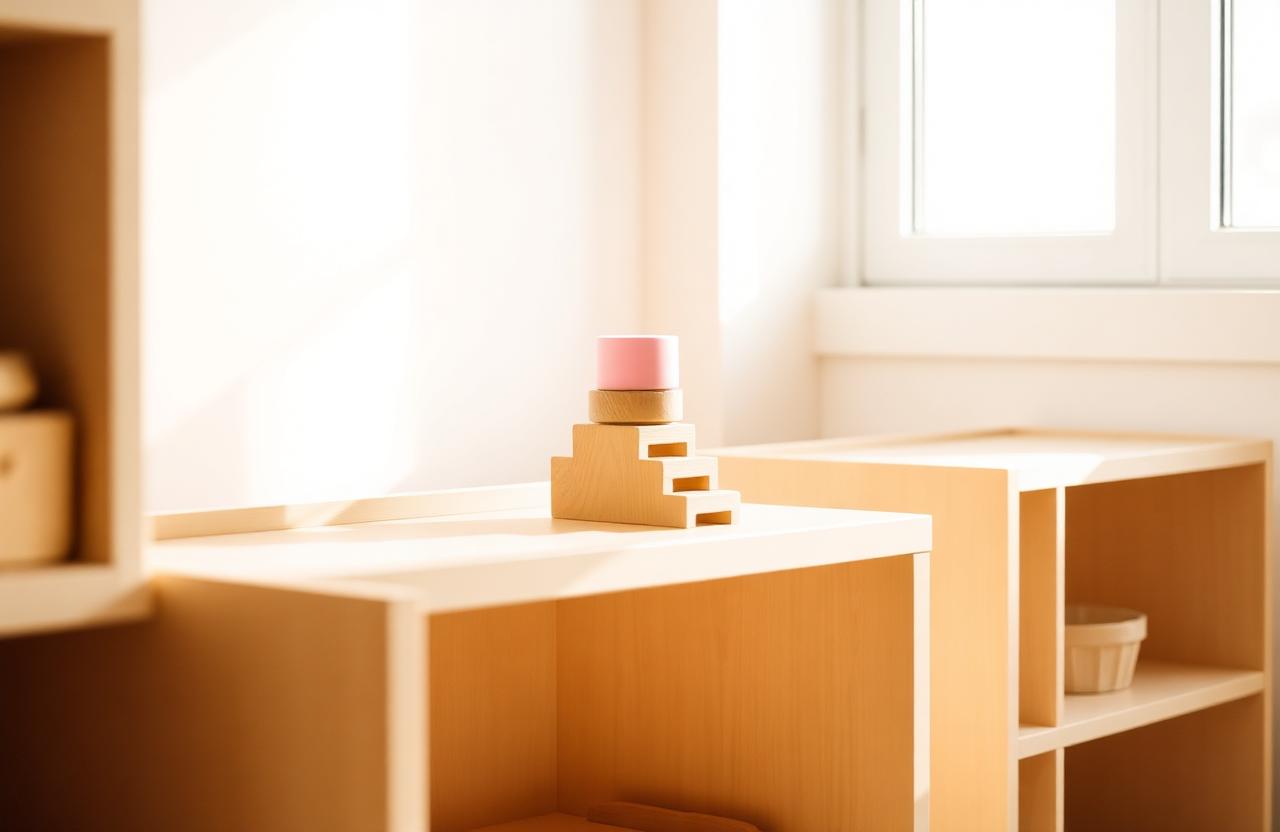
Montessori toys have a deceptively crafty, almost old-fashioned look. Wooden cylinders, smooth beads, simple knobs, plain trays. It would be easy to assume they are the product of taste — a kind of design preference for natural materials over plastic. The truth is more interesting. Almost every detail of a true Montessori material was decided through years of close observation of real children, and most of those decisions are now backed, decades later, by modern developmental psychology and neuroscience. The toys are not pretty by accident. They are the visible end of a very serious experiment.
Dr. Maria Montessori, an Italian physician working at the turn of the twentieth century, was one of the first people to study children the way a scientist might study any other phenomenon: by watching them, carefully, for thousands of hours, and recording what they actually did when given freedom. She noticed that children, far from being little chaos engines, naturally gravitate toward repetitive, focused work when the environment offers the right tools. The right tools, she found, were physical, hand-sized, self-correcting, and each focused on isolating a single concept. That insight became the architecture of every Montessori material in use today.
Take the principle of isolation of a single quality. A Montessori knob cylinder set varies only in diameter or height — everything else, including colour and material, stays constant. Modern cognitive science calls this perceptual learning: the brain forms new categories most efficiently when only one variable changes at a time. Studies on infant categorisation, going back to Eleanor Gibson's classic work in the 1960s and continued by researchers like Linda Smith today, repeatedly show that children identify abstract properties — bigger, longer, heavier — far faster when those properties are presented in isolation rather than tangled together. Montessori arrived at this conclusion empirically, fifty years before the lab confirmed it.
Then there is the control of error, the property that lets a child correct themselves without an adult. A puzzle piece either fits or it doesn't. A jug that pours too quickly spills water. The feedback is immediate, honest, and impersonal. Neuroscience tells us why this matters: prediction-error signals in the brain are one of the primary engines of learning. When a child predicts that a shape will fit, then watches it fail to drop into the hole, that small mismatch lights up dopamine-related learning circuits. Repeated cycles of predict-test-adjust are the developmental equivalent of strength training for the prefrontal cortex.
Hands are the next piece of the puzzle. Montessori famously called the hand 'the instrument of the intelligence,' and modern embodied cognition research has caught up with her on this point too. Studies show that motor experience shapes conceptual knowledge — children who physically manipulate objects develop spatial reasoning, numerical understanding, and even vocabulary faster than those who only watch or listen. The reason wooden toys feature so heavily in Montessori environments is partly practical (they are durable and safe), but mostly cognitive: weight and texture create proprioceptive feedback that purely visual or screen-based learning simply cannot provide.
Concentration, often overlooked, is perhaps the most striking outcome. Montessori observed that children given the right materials would enter what she called 'the great work' — long, uninterrupted periods of deep focus on a single task. Contemporary researchers like Angeline Lillard, a psychology professor at the University of Virginia, have published rigorous comparisons of Montessori and conventional classrooms showing measurable gains in executive function, attention, and self-regulation among Montessori children. Executive function is the foundation of every later academic skill, from reading to arithmetic to writing essays. Toys that train it from age two are doing more long-term work than any flashcard ever will.
Even the aesthetic restraint of Montessori toys has a scientific basis. Cognitive load research shows that visually noisy environments tax working memory, leaving fewer resources for actual learning. A toy in three calming colours and one shape is not boring — it is cognitively generous. The child's attention is free to study the concept, not the surface decoration. This is why Montessori shelves look so spare: the spareness is a feature, not a budget choice.
All of this adds up to something quietly powerful. When you put a wooden cylinder set or a stacking puzzle in front of a toddler, you are not just giving them a nice-looking toy. You are giving them, in physical form, a hundred years of careful observation about how the human mind comes online — observation that today's neuroscience keeps confirming. Montessori toys work because they were designed to match how children actually learn, not how adults assume they should. That match is the science, and once you see it, you cannot un-see it.
Keep reading
More from the journal
How Montessori Toys Stimulate Young Children
Why simple, purposeful toys built on Montessori principles spark deeper concentration, creativity, and confidence in early childhood.
Why Wooden Toys Are Better Than Plastic Toys
From safety and sensory richness to lifespan and environmental impact, here is the honest case for choosing wood over plastic in the toy box.
Why Wooden Toys Are a Perfect Gift for Children
Heirloom-quality, safe, beautiful, and built to last — the gift that still gets played with five Christmases from now.