April 2, 2026 · 6 min read
How Montessori Toys Stimulate Young Children
Why simple, purposeful toys built on Montessori principles spark deeper concentration, creativity, and confidence in early childhood.
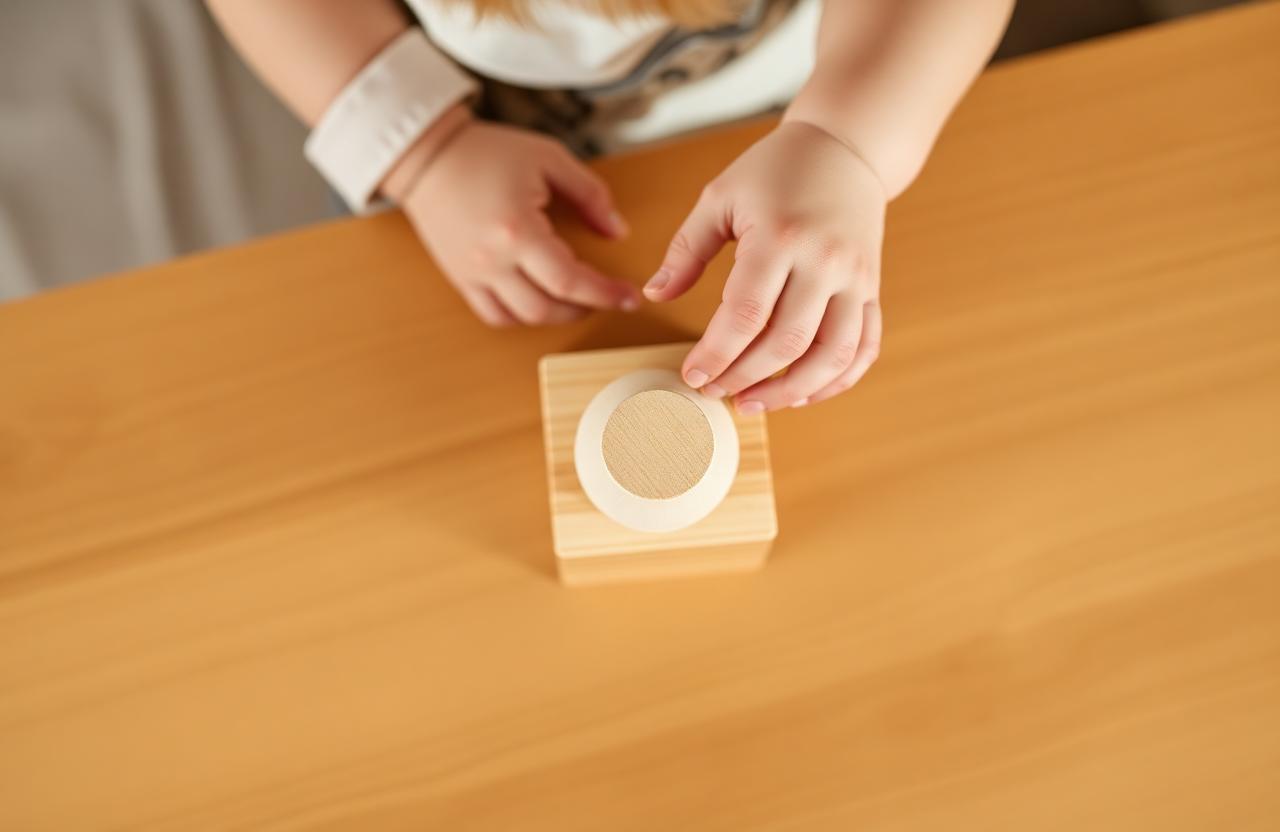
Walk into any Montessori classroom and the first thing you notice is the quiet. Children are working, not playing in the wind-up, light-up sense most parents are used to. They are stacking, sorting, pouring, threading. The toys in their hands look almost suspiciously simple — a wooden cylinder, a set of nesting cups, a string of smooth beads. And yet the focus on those small faces is the kind most adults struggle to summon at their desks. That focus is not an accident. It is the direct result of toys engineered, over a century ago by Dr. Maria Montessori, to do one thing exceptionally well: invite a child to learn through their own hands.
Montessori toys stimulate young children precisely because they do not try to do the stimulating themselves. A toy that sings, flashes, and rolls across the room delivers entertainment, but the child is a passive audience. A wooden shape-sorter does nothing on its own. The child must pick up the triangle, study it, rotate it, test it against the openings, fail, try again, and finally feel that satisfying drop when the shape slides home. Every one of those micro-decisions is a tiny act of cognition. Multiply that by an hour of free play and you have built real neural pathways — concentration, spatial reasoning, fine motor control, perseverance — in a way no battery-powered toy can match.
One of the quietest superpowers of Montessori toys is the principle of isolation of quality. A Montessori knob cylinder, for example, varies only in diameter. A pink tower varies only in size. By holding every other variable constant, the toy forces the child's attention onto one specific concept at a time — bigger, smaller, heavier, lighter, rougher, smoother. Young brains, which are still building their basic categories of the world, find this enormously satisfying. They are not overwhelmed by colour and noise; they are gently led to notice one true thing, then another, then another. Over months, those isolated observations compound into a remarkably sophisticated understanding of the physical world.
Open-ended design is the second engine. A set of wooden blocks is a castle on Monday, a road on Tuesday, a zoo on Wednesday. A nesting set of cups is a tower, then a tunnel, then a tea set, then a hiding place for a tiny acorn. Toys that can only be used one way are exhausted in minutes. Toys that can be used a thousand ways grow with the child, which is why Montessori-aligned wooden toys often stay in rotation for years instead of weeks. That longevity matters for sustainability, but it matters even more for development. A familiar toy revisited at three is not the same toy the child met at one. Older skills layer on top of older memories, and the play becomes deeper every time.
Real materials are another quiet stimulator. Montessori toys are traditionally made from wood, metal, glass, fabric, and natural fibres. These materials have weight, temperature, grain, and consequence — a glass cup teaches care because it can actually break; a wooden block teaches force because it is genuinely heavy. Plastic, by contrast, tends to feel uniform and unreal in the hand. Children pick up on this immediately. When the materials in their toys behave like the materials in the real world, the lessons of play transfer directly into the lessons of daily life: pouring water, helping in the kitchen, carrying a fragile thing across a room.
Perhaps the most underrated benefit is what Montessori called the control of error. A great Montessori toy tells the child, without a word from any adult, whether they have got it right. A puzzle piece either fits or it doesn't. A stacking ring either slides down to the base or stops short. The child is not waiting for praise from a parent or a chirp from a speaker — they are getting honest feedback from the physical world. This builds the kind of internal motivation that makes learning self-sustaining. The reward is the result, not the applause, and children who grow up with that loop tend to become adults who can work on hard things without constant external validation.
For parents wondering where to start, the answer is reassuringly small. You do not need a roomful of materials. A simple set of wooden stacking rings for the under-twos, a shape sorter and threading beads for the toddler years, a set of natural blocks and a few practical-life tools for the preschooler — these handful of well-made objects, rotated thoughtfully, will out-stimulate a closet full of plastic. The trick is to choose toys that respect the child's intelligence, get out of the way, and let the hands do the teaching. That is the whole Montessori secret, hiding in plain sight on every wooden tray.
Keep reading
More from the journal
Why Wooden Toys Are Better Than Plastic Toys
From safety and sensory richness to lifespan and environmental impact, here is the honest case for choosing wood over plastic in the toy box.
The Science Behind Montessori Toys
Montessori materials are not a trend — they are the result of more than a century of careful observation and converging modern neuroscience.
Why Wooden Toys Are a Perfect Gift for Children
Heirloom-quality, safe, beautiful, and built to last — the gift that still gets played with five Christmases from now.