May 7, 2026 · 9 min read
How Wooden Toys Are Made in the Factory
A step-by-step look inside the workshop — how a classic wooden train goes from raw hardwood plank to a finished toy ready to be loved for a lifetime.
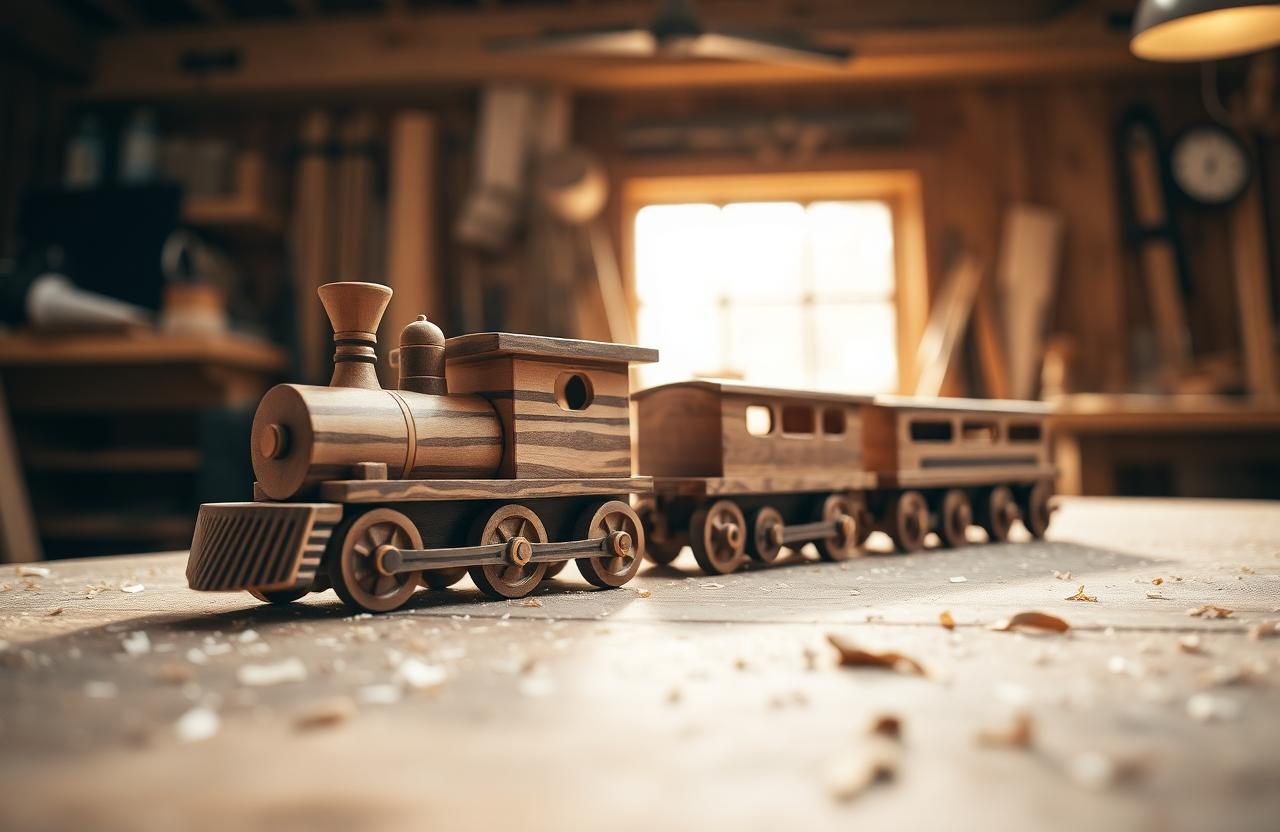
Most parents pick up a wooden toy train, feel its weight, run a thumb over its silky edges, and assume it was made by someone, somewhere, with a lot of patience. They are right. What they usually do not see is the dozen distinct stages, each demanding its own tools and its own kind of skill, that turn a raw hardwood plank into the little locomotive in their hand. The journey from forest to playroom is long, surprisingly slow, and quietly fascinating. This is what actually happens inside a wooden toy workshop, from the first board to the last coat of beeswax.
It begins, long before any tool touches the wood, with the trees themselves. Reputable wooden toy makers source their timber from sustainably managed hardwood forests — typically hard maple, beech, birch, or cherry. These species are chosen for very specific reasons: they have a tight, even grain that resists splintering, they are dense enough to take repeated drops without denting badly, and they sand to a beautiful satin smoothness. After felling, the rough logs are milled into boards and then enter the single most underrated stage of toy making: drying. Boards are stacked with spacers between them and either air-dried for months or kiln-dried for several weeks, until their moisture content is brought down to around eight per cent. Skip this stage, and the finished toy will warp, crack, or split as it acclimates to a heated home. Get it right, and the toy stays dimensionally stable for decades.
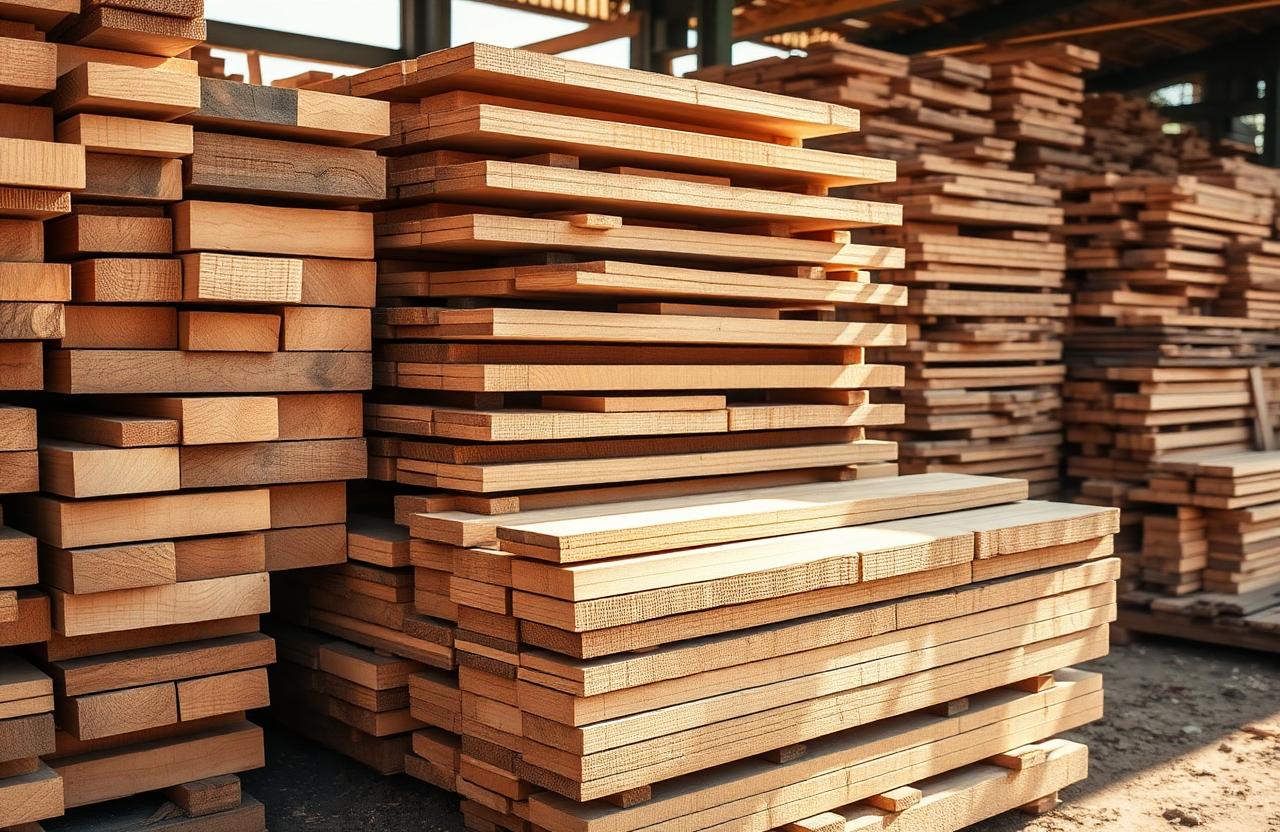
Once the lumber arrives at the workshop, it is inspected board by board. Any plank with knots in the wrong places, internal cracks, sap pockets, or grain that runs the wrong way is set aside for less critical parts or sent back as firewood. Only the cleanest sections of the cleanest boards become toy stock. This first quality gate is brutal — sometimes only sixty per cent of a delivery makes the cut — but it is the single biggest reason a well-made wooden toy feels the way it does. You cannot fix bad wood downstream. Choosing well at the start is the entire game.
With the good stock identified, the workshop moves to rough breakdown. The boards are crosscut to manageable lengths on a sliding mitre saw, then ripped to width on a table saw, producing rectangular blanks slightly larger than the finished parts. For a classic wooden train, this stage produces a small family of blanks: a thick block for the locomotive body, a chunky cylinder of stock for the boiler, slimmer rectangles for each carriage, square dowels for chimneys and couplings, and a separate batch of disc blanks for the wheels. Every piece is labelled and sorted by which part it will become, because once a blank leaves this stage, it will be machined for one specific job and nothing else.
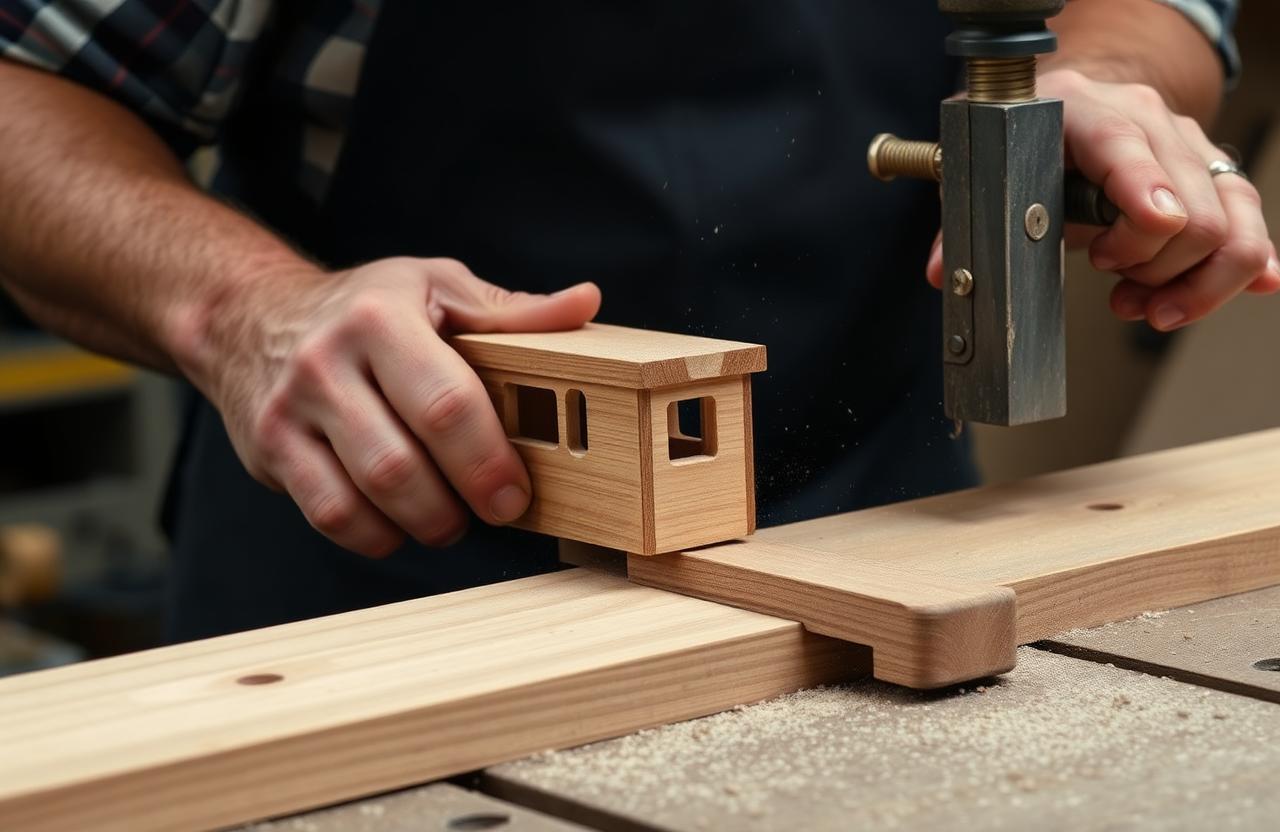
The blanks then move to the band saw and the scroll saw, where the basic silhouette of each part is cut. The locomotive body is shaped to give it the familiar tapered cab and rounded front. Carriage walls have their window openings cut out. Roof pieces are angled slightly so they sit flush. A good wooden train is not just a stack of boxes — it has gentle curves and chamfers that make it feel alive in the hand, and almost all of that character is roughed in at this saw stage. The cuts are deliberately left a fraction oversized, because the next stages will refine them down to the final dimension.
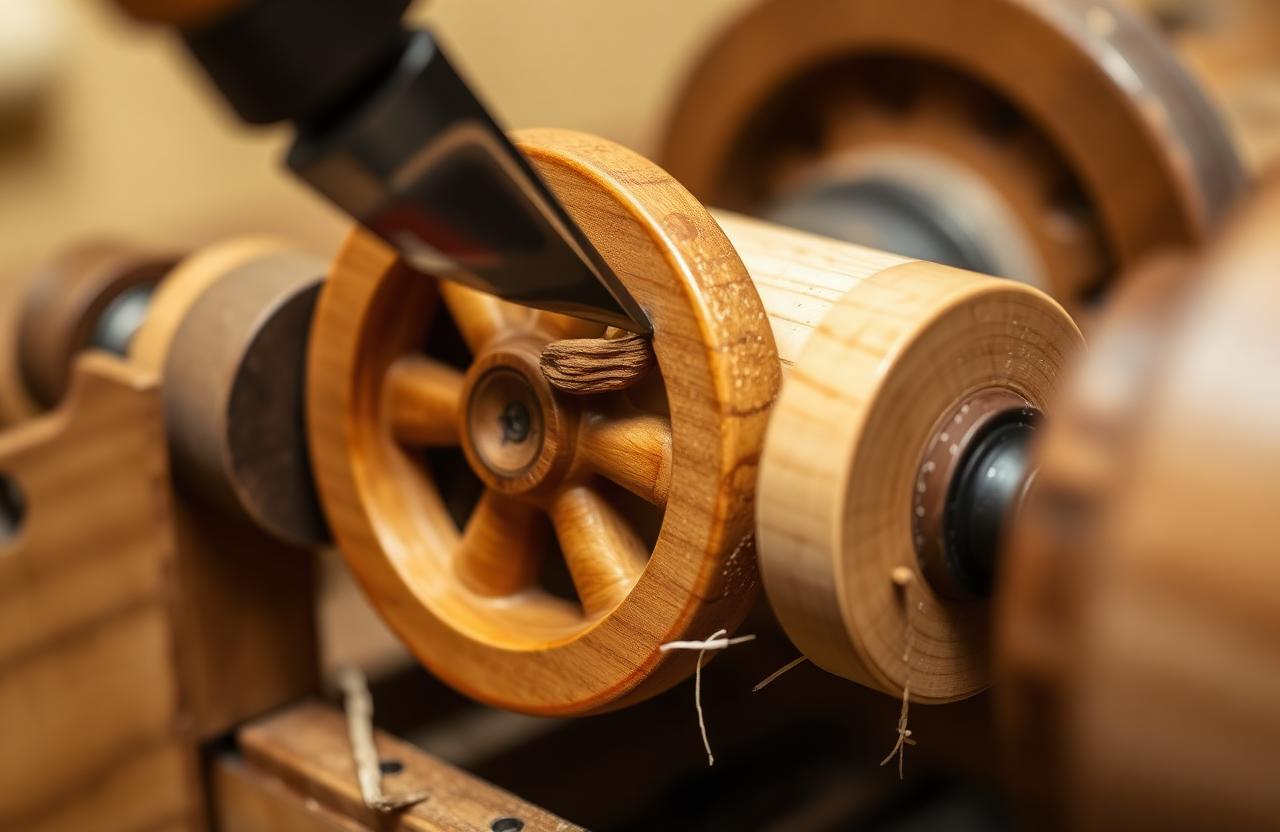
Now comes one of the most satisfying steps to watch: the lathe. Wheels, boilers, smokestacks, and any cylindrical part are turned from square stock between centres on a wood lathe. A skilled turner can shape a perfect train wheel — with its raised hub, central axle hole, and slightly chamfered rim — in under a minute, using a small handful of chisels and gouges. Larger workshops use automated copy lathes that reproduce a master shape with mechanical precision, but the principle is the same. Long curls of fresh shavings fall onto the floor, the workshop smells like maple sap, and what was a featureless dowel becomes, in a few passes, a recognisable wheel.
Drilling and joinery follow. Each wheel needs an axle hole drilled exactly through its centre. The locomotive body needs a smokestack hole on top, coupling holes at front and back, and four perfectly aligned axle holes underneath. Carriages need matching coupling holes so the magnets or hooks will meet. This is precision work — even half a millimetre of drift and the wheels will wobble or the cars will not couple cleanly. Workshops use jigs and drilling guides for every single hole so that the hundredth train looks and rolls exactly like the first. Where parts join, dowels and food-safe wood glue are used; nails, staples, and screws are deliberately avoided, because nothing metal belongs in a toy meant to be chewed on by an eight-month-old.
With the parts machined and the holes drilled, the workshop enters the longest and most labour-intensive phase: sanding. Every surface, every edge, every corner is sanded by hand through three or four progressively finer grits, typically starting around 120 and finishing at 320 or 400. Sharp corners are eased off until they feel rounded to a soft fingertip — there should be no edge anywhere on the toy that could cut, scratch, or splinter a child. Wheels are rolled against sanding discs to make sure they spin true. The locomotive body is inspected from every angle. A good toymaker will sand a single train for fifteen or twenty minutes before they are satisfied. This is the stage that separates a toy that feels expensive from one that feels like a hardware-store kit.
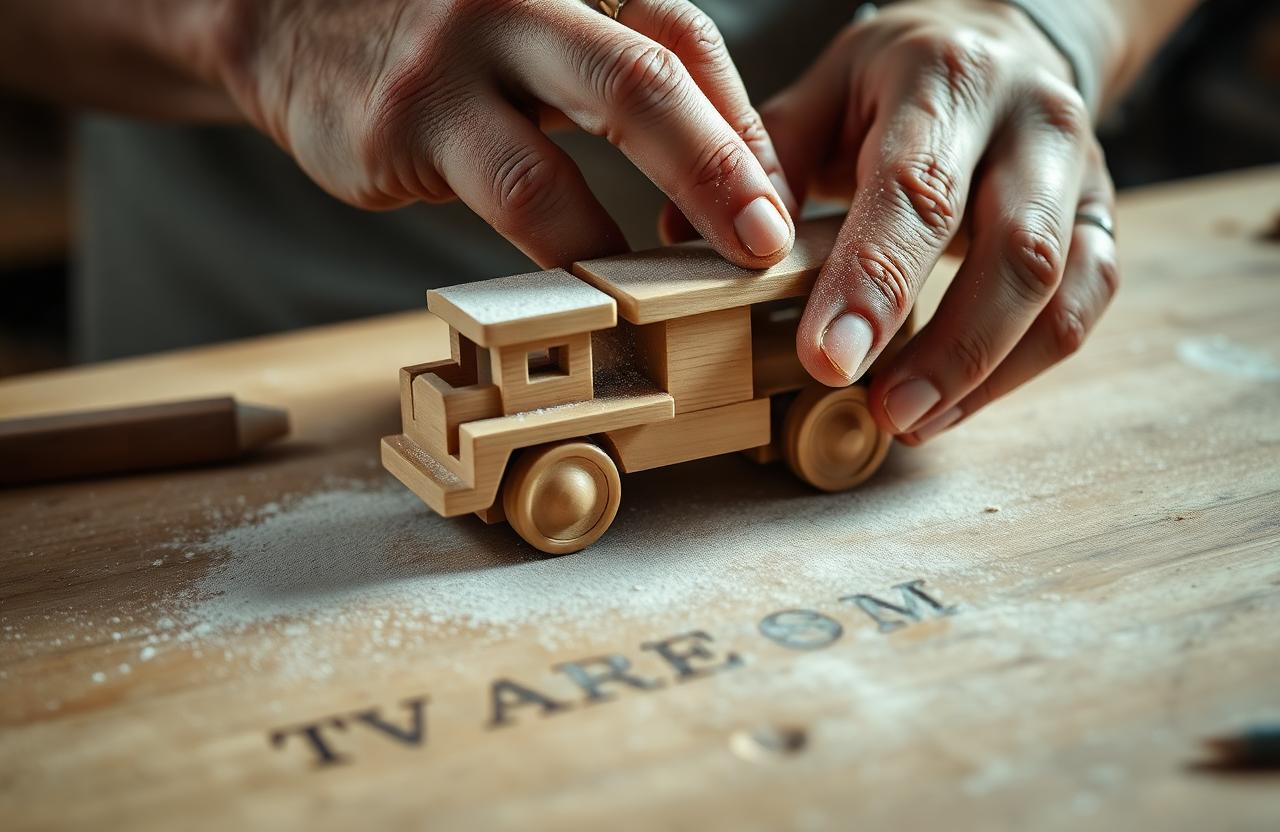
After sanding, every piece is blown clean and wiped with a tack cloth to remove the finest dust. Then comes a critical safety stage: dry assembly and quality inspection. Each part is checked against a master template, weighed in the hand, rolled across a flat surface to confirm the wheels track straight, and gently dropped from a small height to make sure nothing splinters or fails. Any part that does not meet the standard is rejected on the spot. Children, and the regulations that protect them, do not allow for 'almost.' Small parts are also passed through a small-parts cylinder — a standardised test tube used worldwide to confirm that nothing detachable could become a choking hazard for a child under three.
Once the bare wood has passed inspection, the parts move to the finishing room. Quality wooden toys are finished with non-toxic, food-grade materials: usually a base coat of pure linseed or tung oil to penetrate the grain, followed by a top coat of natural beeswax. Some workshops use plant-based pigment stains in soft, muted colours, but these stains are always specifically certified for toys and tested to be free of heavy metals and migratable chemicals. The finish is applied thinly, by brush or cloth, allowed to soak in for several minutes, then buffed back to a soft satin sheen. This is the moment the wood truly comes alive: the grain darkens, the figure pops, and the toy stops looking like a piece of timber and starts looking like an heirloom.
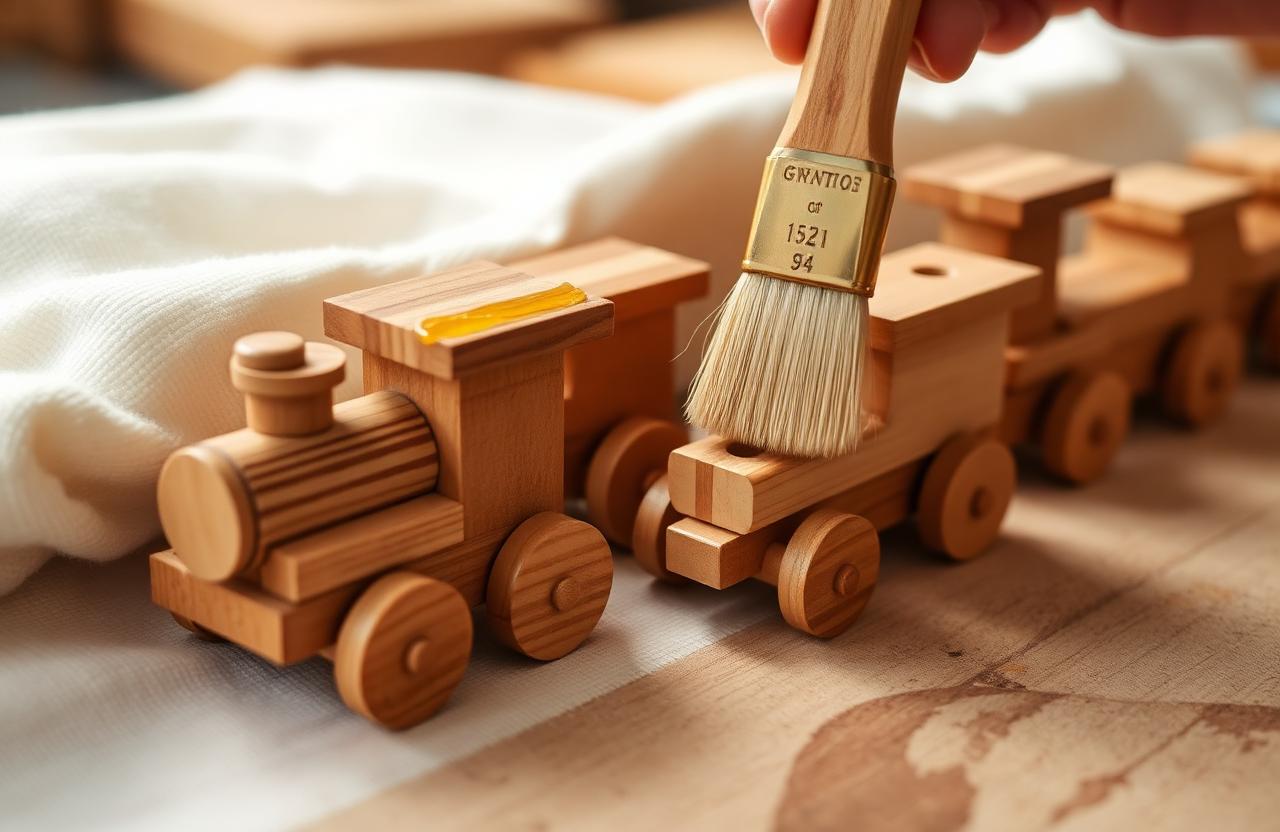
Between coats, the parts cure on open racks for anywhere from twelve to forty-eight hours, depending on humidity. Rushing this stage leaves a finish that feels slightly tacky or smells faintly of oil for weeks; respecting it produces a surface that is dry, food-safe, and pleasant from the moment the toy leaves the workshop. Some makers will apply two or three coats, lightly burnishing the wood with fine steel wool between each one. This is invisible work that no customer ever sees directly, but every customer feels it the moment they pick the toy up.
Final assembly is almost ceremonial. The cured wheels are slipped onto their axles, often pre-waxed so they spin freely for life. The axles are tapped into the locomotive and carriage bodies with a small mallet, set deep enough to hold tight but never so deep that the wheels bind. Magnetic or hook couplings are pressed into their pre-drilled seats. Smokestacks and cab roofs are glued and clamped. Each completed train is then rolled across a long, flat bench — a simple but effective test — to confirm it tracks straight and that every wheel spins. A train that wobbles or veers is taken apart, diagnosed, and rebuilt.
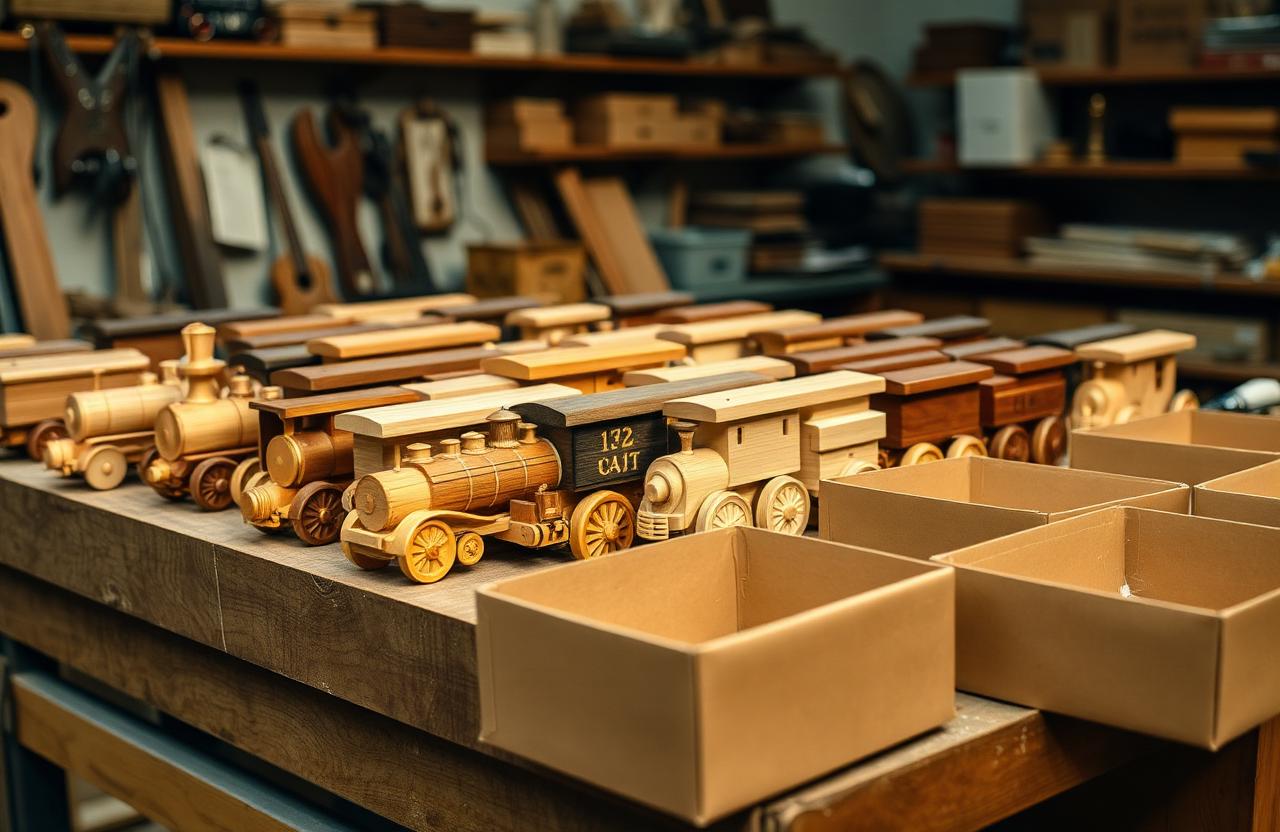
The very last step is one that good workshops take seriously: a second, final inspection by a different pair of eyes. Every train is examined for finish defects, sharp edges that escaped the sander, loose wheels, misaligned couplings, and any cosmetic flaw that would disappoint a child or a parent. Pieces that pass are labelled, sometimes engraved with a serial number or a maker's mark, wrapped in tissue, and packed in plain kraft boxes designed to be reused or composted. From kiln-dried plank to packed product, a single classic wooden train typically passes through the hands of three to five different craftspeople and takes the better part of a working day to complete — not counting the weeks of drying time before the first cut.
When you understand all of that, the price of a real wooden toy starts to look less like a luxury and more like an honest sum. You are paying for sustainably harvested hardwood, months of patient drying, painstaking hand-finishing, food-safe finishes, jig-based precision, and multiple layers of safety inspection. You are also paying for an object that, cared for casually, will outlast its first owner and very likely its second. The same wooden train passing through a Canadian workshop today will, with luck, be in a grandchild's hands in fifty years — still rolling, still smelling faintly of beeswax, still doing the slow, beautiful work it was so carefully built to do.
Keep reading
More from the journal
How Montessori Toys Stimulate Young Children
Why simple, purposeful toys built on Montessori principles spark deeper concentration, creativity, and confidence in early childhood.
Why Wooden Toys Are Better Than Plastic Toys
From safety and sensory richness to lifespan and environmental impact, here is the honest case for choosing wood over plastic in the toy box.
The Science Behind Montessori Toys
Montessori materials are not a trend — they are the result of more than a century of careful observation and converging modern neuroscience.