April 30, 2026 · 6 min read
Choosing the Right Wooden Toy by Age
A practical, age-by-age guide to picking wooden toys that match a child's stage — from grasping rattles to elaborate building sets.
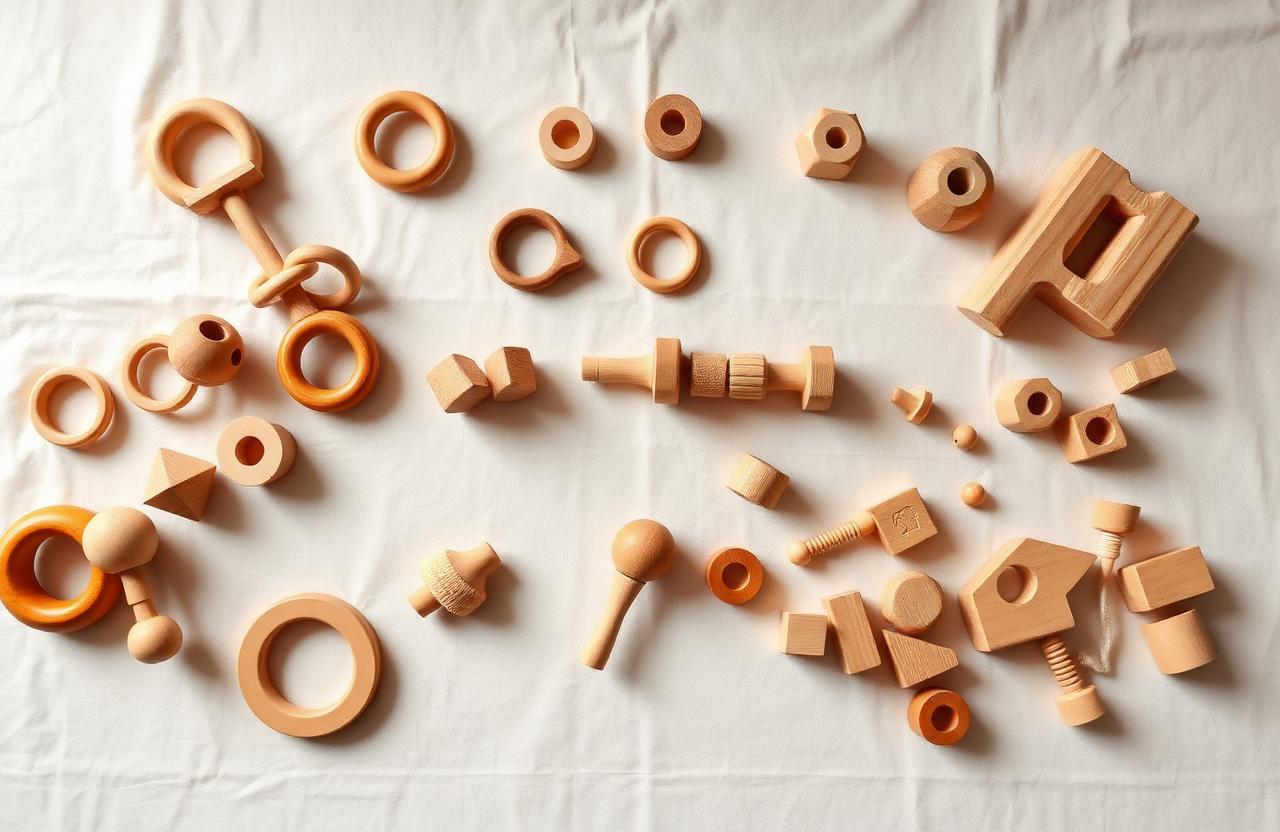
Wooden toys have a wonderful habit of looking timeless, which can make it surprisingly hard to figure out which ones are right for the child in front of you. A set of beautiful blocks is gorgeous on the shelf, but for a six-month-old it is mostly a tripping hazard. A grasping rattle is exquisite at four months and almost ignored by age three. Choosing the right wooden toy is less about taste and more about meeting the child exactly where their hands, attention, and curiosity currently are. The good news is that there is a sensible pattern, and once you know it, gifting and shopping become much easier.
From birth to about six months, babies are doing two enormous jobs: making sense of light and sound, and learning that their hands belong to them. The wooden toys that help most are minimal, high-contrast, and easy to grip. A smooth wooden rattle, a simple grasping ring, or a clutch toy with a few wide-spaced beads gives the baby something safe to pull toward their mouth, study with their eyes, and shake. Look for very smooth, sanded edges, food-safe finishes, and a piece small enough to grip but large enough to never become a choking hazard. Less is genuinely more at this stage.
From six months to a year, sitting begins, and so does the wonderful era of putting things into other things. Stacking cups, nesting boxes, simple wooden rings on a post, and large wooden balls that can be picked up and dropped repeatedly are perfect. The baby is learning object permanence, cause and effect, and the basics of spatial reasoning, all by lifting one object and placing it inside or on top of another. Choose toys that can survive being gnawed, banged on the floor, and dropped from a high chair at least a thousand times. Real hardwood with a beeswax finish is built for exactly this kind of life.
Between one and two, walking arrives and so does intention. Pull toys, push wagons, and simple shape sorters come into their own. The toddler now wants to make something happen — to drag a wooden duck across a room, to fit the square block into the square hole, to load a wooden cart with smaller objects and unload it again. This is also the moment to bring out a first set of chunky wooden blocks. They will mostly be knocked over rather than built with, but that knocking is real engineering — the child is learning gravity, balance, and the satisfying limits of stacking.
From two to three, pretend play explodes. Suddenly the toy is not just an object but a character, a vehicle, a meal, a hospital. Wooden food sets, simple wooden animals, a small toolkit, a tea set, or a wooden train track turn into the props of an inner world that is rapidly becoming richer than anything on a screen. Open-ended pieces win here: a single wooden block is a phone, a sandwich, a bed for a tiny animal, then back to a block. Avoid toys that lock the child into one storyline. The most-loved toys at this age are usually the most ambiguous.
Three to four is the golden age of fine motor work. Threading beads, lacing boards, simple wooden puzzles with knobs, peg boards, and basic Montessori practical-life sets — pouring, scooping, transferring — all hit at exactly the right moment. The child's pincer grip is now strong enough to enjoy small, precise work, and the satisfaction of getting it right is enormous. Building sets can grow more sophisticated too: arches, ramps, and a few specialty pieces transform a basic block collection into a city.
From four to six, complexity becomes the gift. Larger construction sets, wooden marble runs, more challenging puzzles, basic strategy games, and dramatic-play setups (kitchens, workbenches, dollhouses) all serve a child who can now hold a project in mind across hours and days. This is also when first art and craft tools — a wooden easel, a set of natural wooden pencils — start to matter. Children at this stage want to make and finish things, not just explore them, and toys that allow for that arc are deeply satisfying.
From six and up, wooden toys do not retire — they evolve. Quality wooden chess and checkers sets, model-making kits, simple wooden musical instruments, and heirloom-quality strategy games stay in rotation for years and often follow the child into adolescence. By this age the value of a wooden toy is partly nostalgic and partly aesthetic: it looks like something worth keeping, because it is. Many of the wooden games bought at six are still on shelves at sixteen, occasionally pulled down for a rainy afternoon.
A last bit of practical advice: when in doubt, choose slightly younger rather than slightly older. A well-made wooden toy for a one-year-old will absolutely still be loved by a two-year-old; a toy aimed at four can frustrate a two-year-old into ignoring it entirely. Aim for the child's current hands, not the child you imagine they will be in a year. The toy will grow into them naturally, the way wooden toys always have.
Keep reading
More from the journal
How Montessori Toys Stimulate Young Children
Why simple, purposeful toys built on Montessori principles spark deeper concentration, creativity, and confidence in early childhood.
Why Wooden Toys Are Better Than Plastic Toys
From safety and sensory richness to lifespan and environmental impact, here is the honest case for choosing wood over plastic in the toy box.
The Science Behind Montessori Toys
Montessori materials are not a trend — they are the result of more than a century of careful observation and converging modern neuroscience.